
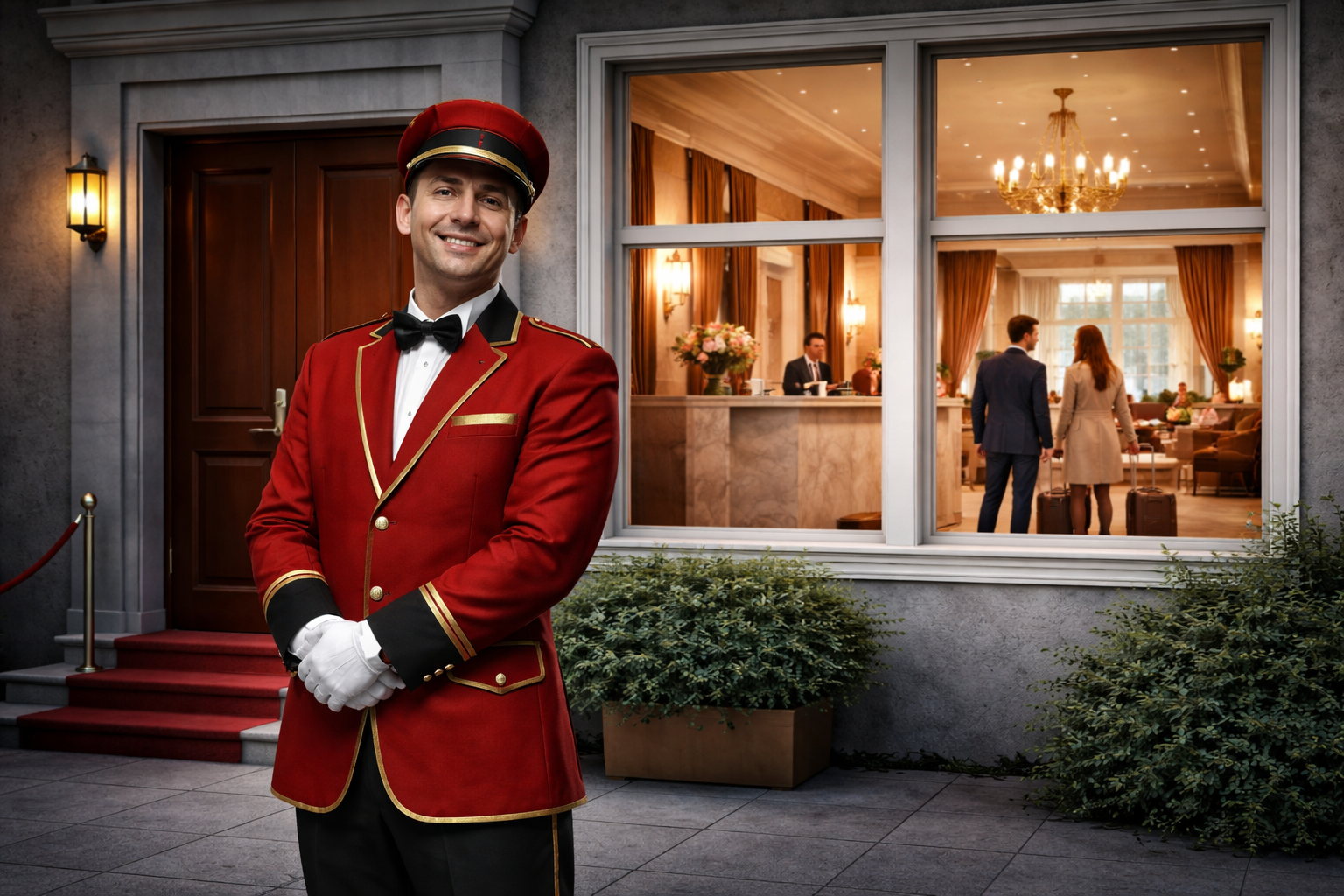
Let’s imagine you’re in London for a weekend. You’ll see elegant hotels – perhaps you’ll be lucky enough to stay in one. You’ll sense the quiet prestige of places like The Ritz, quietly rising above the hurly-burly. Outside, the perfectly composed doorman seems like part of the building itself. He’s doing a great job, and enjoying it. But what can that teach you about how you run your business?
That hotel employee is the hero of this blog. He’s a reminder that in every business there is a balance between being efficient and being effective. If we only focus on the former, we will make a strategic mistake and may fail altogether.
A well-paid doorman might seem inefficient. Their job includes greeting guests, helping with luggage and hailing taxis. A manager who’s looking only at costs might conclude that guests are perfectly capable of doing these things themselves. After all, most of us are used to opening doors. So a question raises its head – why pay someone to do it?
If you view the doorman’s role only through the lens of efficiency, the doorman seems unnecessary. Making him or her redundant would be a decent cost saving. But this conclusion is probably wrong, because it misses their real value.
One person, endless jobs
Let’s think about the things he does that don’t involve opening doors. To newcomers, he is a reassuring presence. He’s the first sign they’ve arrived somewhere that matters. To returning guests, he is a constant in a bustling city. The hotel’s valuable customers feel looked after, especially when they’re acknowledged.
To the hotel itself, he is both guardian and gatekeeper. He keeps an eye up-and-down the street, deterring noise, petty crime and anti-social behaviour. In his velvety black coat and polished brass buttons, he’s both Neighbourhood Watch and security guard.
Welcome to the ‘Doorman Fallacy”
This classic example of the doorman at a high-end hotel comes from Alchemy, a book written by marketing thinker Rory Sutherland. His ‘Doorman Fallacy’ describes this mistake of removing something that appears inefficient because its value is difficult to measure.
We don’t know how much The Ritz pays its doormen. Let’s say that £200k is a reasonable estimate for the cost of employing them, 24/7, over a year. It’s a lot of money. But we think that Rory Sutherland is right. Their value is a no-brainer when you factor in the benefits they deliver that are hard to measure – the customer satisfaction, the brand, the security. All these mean the hotel can keep charging its higher prices with confidence.
The Doorman Fallacy contains important lessons for all business owners. In business, it’s tempting to focus only on things we can see in a spreadsheet. Reduce our costs. Strip out things that don’t directly generate sales. However, some things that appear inefficient on that spreadsheet can actually create enormous value.
Why this matters
Rory’s idea comes from a new-ish discipline called behavioural economics. It shows us how our decisions are often driven by our emotions. So damaging your emotional appeal can weaken a business, even if the cost savings look attractive.
Most of us don’t run luxury hotels. But here are three more examples:
- Towns in rural areas often see their banks close branches as many customers move online. From a cost perspective, this makes sense. Online systems are cheaper to run. But physical branches always play an important role beyond transactions. When they disappear, banks sometimes save money but lose customer confidence. Their customers are now more likely to shop around.
- Some law firms and medical practices consider moving to self check-in systems. However, a receptionist performs an important psychological role. They greet and re-assure people, creating a professional atmosphere. A good receptionist, like the doorman, is not just performing a task. They are shaping the experience.
- Many companies push customers toward automated systems and chatbots to reduce support costs. Automation has its place, but eliminating human support can backfire. When customers face a stressful problem, speaking to a real person can dramatically improve satisfaction.
Looking for invisible value
As Rory Sutherland argues, human behaviour is shaped by perception, not logic. Small signals – like a friendly receptionist, a physical presence, or accessible customer support – influence how people feel about a company. Before removing something that appears inefficient, consider what invisible value it might be providing.
Three questions for your business
When evaluating an expense, ask:
- Does this cost influence customer perception? Some things signal professionalism, quality, or reliability to your customers and suppliers.
- Does it reduce anxiety or friction? Many valuable services work by making customers feel comfortable or reassured.
- Would removing it weaken your brand or reputation? Some things provide intangible value that only becomes noticeable when they’re gone.
If the answer to any of these questions is yes, the apparent inefficiency may be strategically important. As accountants, it pains us to say this – but not every valuable thing shows up neatly in the numbers!
Learn more: Alchemy: The Magic of Original Thinking in a World of Mind-Numbing Conformity
How Merlin can help
To find out more about how we can help your business, please contact us. Our clients say that it’s useful to have a numerate friend prodding their thinking, especially one who understands the issues. If you’re not already a client, please get in touch here. You’ll find us a good fit if you’re looking for an accountant as an investment – rather than just a cost.