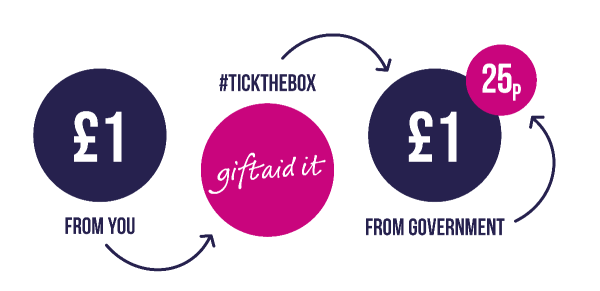
…..by ticking the Gift Aid box when making donations to charities.
As accountants, we’re often asked about the most efficient ways to support good causes. One of the most effective – and very often overlooked – is Gift Aid. It’s a long-standing government initiative that allows charities to claim an additional 25p for every £1 donated, at no extra cost to the donor. Yet despite its clear benefits, many people either don’t fully understand how it works, think they’ll end up donating more or aren’t sure if they’re eligible to use it.
In this blog, we’ll take a look at the history of Gift Aid, how it works in practice, and some of the common reasons donors don’t always tick the box.
A short history of Gift Aid
Gift Aid was first introduced by the UK government in 1990. At the time, it applied only to substantial donations of £600 or more, which meant it had limited reach. Recognising the need to make the scheme more inclusive, the rules were relaxed in 2000 so that Gift Aid could apply to all donations, regardless of size.
Since then, it has become one of the most important sources of income for charities. In fact, it’s estimated that UK charities now claim well over £1 billion each year through the scheme – vital extra funds that support everything from medical research to local community projects.
How Gift Aid works
Gift Aid works by allowing charities to reclaim the basic rate of income tax (currently 20%) on donations made by UK taxpayers.
Here’s how that would look in practice:
- A supporter gives £20 to a charity.
- If they tick the Gift Aid box, the charity can reclaim £5 from HMRC.
- That means the charity actually receives £25.
There’s good news for higher and additional rate taxpayers, as there’s an additional benefit. You can reclaim the difference between the basic rate and your highest rate of tax through your self-assessment tax return. Many choose to donate that extra saving back to the charity, effectively increasing the value of their original gift even further.
Why do some donors not Gift Aid their donation
Given that Gift Aid boosts the value of donations without costing donors anything extra, it may be surprising that not everyone chooses to use it. Some common reasons include:
- Uncertainty about tax status – Donors must have paid enough UK Income Tax and/or Capital Gains Tax in the same tax year to cover the amount the charity reclaims. If someone is unsure about their tax position – for example, retirees or those with low taxable income – they may prefer not to tick the box to avoid any issues.
- Confusion about the rules – The declaration wording can sometimes feel overly formal. Donors worry about getting it wrong, even though charities provide clear guidance and HMRC takes a pragmatic approach.
- Privacy concerns – To claim Gift Aid, charities must have the donor’s full name and address. Some donors are hesitant to share personal details, particularly for small or one-off gifts. If your donation is under £30, then you don’t need to provide your details and the charity can put it into the Small Gift Aid Donation’s box.
- Donating on behalf of others – If the money donated isn’t from the donor’s own taxed income (e.g. a company that you own), Gift Aid cannot be applied.
- Simply overlooking it – In the rush of making an online donation or setting up a direct debit, it’s easy for donors to miss the Gift Aid tick box altogether.
A quick checklist: Can you Gift Aid your donation?
We’ve created a checklist so that before you tick the box, you can ask yourself the following:
- ✅ Am I a UK taxpayer (Income Tax and/or Capital Gains Tax)?
- ✅ Have I paid at least as much tax this year as the charity will claim back?
- ✅ Is this donation coming from my own money (not on behalf of a group or company)?
- ✅ Am I happy to provide my full name and home address to the charity?
- ✅ If I’m a higher or additional rate taxpayer, do I want to reclaim the extra relief through my tax return – and perhaps pass it on to the charity?
If you can answer “yes” to these, then Gift Aid could be a simple way to make your donation go further.
Common pitfalls that occur with Gift Aid
While Gift Aid is simple in principle, there are a few situations where mistakes can creep in. These don’t usually cause serious problems, but they can stop charities from being able to reclaim the extra 25%. Some of the most common include:
- Not Updating Your Details – If you change address and don’t tell the charity, they may not be able to claim Gift Aid because HMRC requires an up-to-date home address.
- Donating Through Payroll Giving – Payroll giving is already tax-efficient, so Gift Aid does not apply. Some donors mistakenly tick the box, but in this case no additional tax can be reclaimed.
- Joint Accounts – If you donate using a joint account, only the taxpayer named on the Gift Aid declaration is eligible. If the donation actually comes from the other account holder, the Gift Aid claim may not be valid.
- Using Non-Taxed Income – Gift Aid can only be applied to donations made from income that has been taxed in the UK. If your tax position changes (for example, if you retire or your income drops below the personal allowance), you may no longer be paying enough tax to cover the Gift Aid. It’s important to review ongoing declarations and cancel them if needed.
How does not Gift Aiding your donation affect a charities work?
We work with a number of local charities and making a Gift Aid claim for donations is a key source of income. Over the last 18 months our charities have lost out on nearly £2,000 in potential Gift Aid. This money could’ve been used to provide:
- 260 hot meals to the elderly and vulnerable
- 8 people with an 8 week course to help with Food Addiction
- Support to 10 young women between 12 – 16 years old with their mental wellbeing
Final Thoughts
Gift Aid has been part of the UK charitable landscape for more than 30 years, and it remains one of the simplest ways for donors to increase the value of their support. If you’re a UK taxpayer, it’s well worth considering whenever you make a donation.
As accountants, we know that small changes in the way you give can make a significant difference. Gift Aid is the perfect example: a straightforward mechanism that benefits both donors and charities, ensuring that generosity goes further.
If you’d like tailored advice on making your charitable giving as effective as possible – whether through Gift Aid, tax planning, or legacy giving – our team would be happy to help.